03 March 2026
|
Story Martinette Brits
|
Photo Stephen Collett
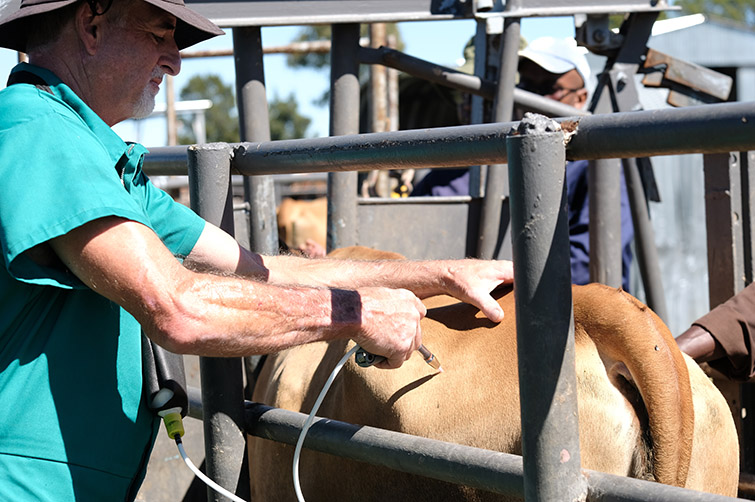 Vaccination underway: Dr Stephan Wessels vaccinates dairy cattle at the Paradys Experimental Farm as the University of the Free State takes proactive steps to safeguard livestock, research, and hands-on student training against foot-and-mouth disease.
The University of the Free State (UFS) has launched a comprehensive foot-and-mouth disease (FMD) vaccination programme at the Paradys Experimental Farm, enabling the responsible reopening of practical training, research activities, and community engagement initiatives that were suspended due to regional outbreak risks.
On Monday, 2 March, the first phase of vaccinations commenced. By the end of the process, 654 animals – including 154 dairy cattle, 200 beef cattle, and 300 sheep – will have been vaccinated, with booster doses scheduled in line with veterinary protocol.
Foot-and-mouth disease is a highly contagious viral disease affecting cloven-hoofed animals such as cattle, sheep, goats, and pigs. Although it poses no risk to human health, it spreads rapidly in unvaccinated populations and has serious economic implications due to production losses and movement restrictions.
When FMD was identified in the broader region, the Experimental Farm Management Committee implemented precautionary measures. From November last year, unnecessary movement onto the farm was suspended – including student access and the movement of research animals.
Restoring hands-on training and research
The restrictions had immediate academic consequences. Undergraduate practical sessions were halted, and postgraduate animal trials were paused due to movement limitations.
“As the head of the Department of Animal Science, it’s very important for us that these animals be vaccinated today,” said Prof Errol Cason. “I think it’s very important for the University of the Free State to be leaders for the local communities and for the local farmers.”
Without access to the farm, students were unable to complete essential practical components of their training. “Animal Science students need to have their feet on the ground – actually feet in the mud between animals, working with them,” he said.
Vaccination now allows the farm to reopen responsibly for both teaching and research. “If these animals are vaccinated, the farm can actually be opened again,” Prof Cason said. “Being vaccinated effectively kickstarts our postgrad research as well as our pre-grad training once again.”
The vaccination process is being overseen by Dr Stephan Wessels, a private veterinarian in Bloemfontein responsible for herd health at the Paradys Experimental Farm. The vaccine, imported from Argentina, targets strains prevalent in the region.
“The vaccine contains two strains – the SAT1 and SAT2 strains, which mostly occur in the Free State – so we are satisfied that it will provide good immunity for this herd,” he said.
Although the university maintains a closed and well-managed herd, its location increases potential exposure risk. “We are therefore doing this preventatively to ensure good immunity in this herd,” Dr Wessels added.
The farm is situated near communal grazing areas and borders both the N1 and N6 highways, where livestock transport is frequent. According to Johan Barnard, Farm Manager, this strategic location – central to the farm’s service role – also places it in a higher-risk zone. As a precaution, animals have been centralised within the core of the farm to reduce vulnerability and to limit exposure.
The vaccine provides approximately six months of immunity, after which booster doses will be administered. Strict cold-chain protocols are followed to ensure efficacy, and dairy cattle are vaccinated intramuscularly to minimise injection-site reactions and protect milk production.
Biosecurity, community engagement, and operational resilience
The biosecurity restrictions extended beyond teaching and research. Farmers’ days, workshops, and short courses – including wool processing training presented at the farm’s facilities – were suspended, and cheese production was halted.
“The community engagement component has also been impacted,” said Barnard. “We were unable to do this because the risks were too high. Now we can start facilitating again.”
Despite these disruptions, the farm continued operating under strict compliance measures.
“We must set the example and remain compliant, because the farm is a registered production unit in addition to being a research unit,” Barnard said.
The vaccination drive forms part of broader biosecurity measures implemented on the farm. Enhanced access control protocols were introduced at the main entrance to regulate movement and minimise risk. Barnard expressed his appreciation to Noko Masalesa – Senior Director: Protection Services at the UFS – and his team for strengthening these measures.
With vaccinations underway, the UFS is positioned to reopen the Paradys Experimental Farm responsibly – restoring essential hands-on training, resuming postgraduate research, and reactivating community engagement initiatives.
In doing so, the university reinforces its commitment to agricultural leadership, responsible livestock management, and the protection of both academic and production assets – contributing meaningfully to the creation of responsible societal futures in the communities it serves.