03 March 2026
|
Story Tshepo Tsotetsi
|
Photo Tshepo Tsotetsi
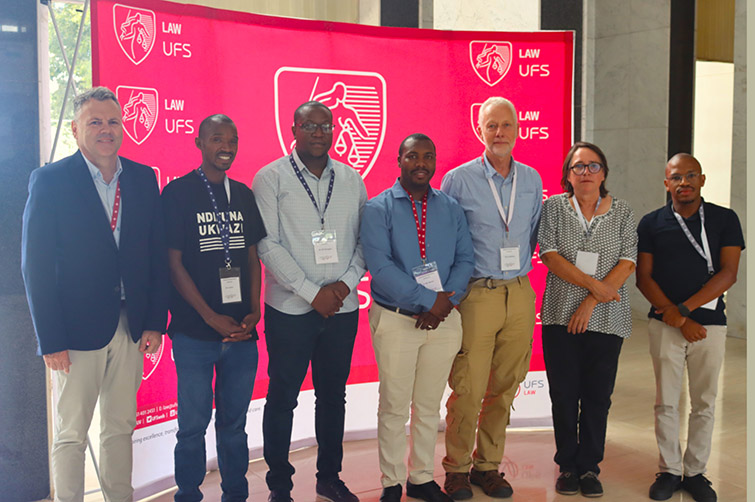 The Free State Centre for Human Rights brought together academics, legal practitioners, municipal officials, and civil society organisations to discuss the role of litigation and collaborative strategies in addressing municipal dysfunction.
As communities across South Africa increasingly turn to the courts to compel municipalities to fulfil their constitutional and statutory obligations, litigation has become a central feature of the country’s governance landscape. It was within this context that the University of the Free State’s (UFS) Free State Centre for Human Rights in the Faculty of Law convened a conference titled ‘Litigating Municipal Failure in South Africa?’
The question mark in the title signalled a deliberate pause for reflection: is litigation a sustainable mechanism for addressing municipal dysfunction, or does it expose deeper structural weaknesses within the local sphere of government?
The conference brought together academics, legal practitioners, municipal officials, civil society organisations, and policymakers, including Lawyers for Human Rights, the Socio-Economic Rights Institute of South Africa, the Centre for Applied Legal Studies, Equality Collective, and the South African Human Rights Commission, to explore the practical, legal, and institutional challenges of addressing municipal dysfunction through litigation.
Supporting municipal governance
Prof Danie Brand, Director of the Centre, said, “Our recent work has involved litigating issues around water provision and housing in municipalities across the province.”
He indicated that these cases have increasingly brought the Centre into direct engagement with governance challenges at municipal level, prompting the need for broader reflection on the role of litigation in responding to institutional dysfunction.
Dr Martie Bloem, Legal Coordinator at the Centre, said the conference was shaped by the Centre’s direct experience in public interest litigation. “The conference was motivated by our lived experience, as a public interest law centre, that litigation alone does not always secure meaningful or sustainable relief for communities affected by municipal failure. While court orders can affirm constitutional rights, implementation gaps, capacity constraints, and political resistance often undermine their impact.”
She added that the intention was to contribute practical insight to broader debates on accountability. “Our aim was to bring together organisations working directly with affected communities to assess what actually works in practice. Ultimately, the goal was not to dismiss litigation, but to refine and strengthen its role within a broader ecosystem of accountability tools aimed at restoring responsive, constitutional local governance.”
Commissioner Dr Henk Boshoff of the South African Human Rights Commission addressed the role of courts in addressing these failures, emphasising that while litigation is an important tool, it is not a complete solution. “It does not always fix institutional systemic failures and is often a costly exercise,” he said. “We cannot litigate ourselves out of municipal dysfunctionality. Litigation has imperfections, but it remains a potent tool in addressing municipal dysfunctionality.” His comments highlighted the limitations of relying solely on legal remedies in the face of deeply entrenched institutional problems.
He further stressed the need for additional mechanisms that work alongside litigation. “We need complementing mechanisms to work hand in hand with litigation and involve other stakeholders in addressing municipal dysfunctionality,” he said. Dr Boshoff pointed to the importance of oversight, intergovernmental support, and sustained engagement with municipalities as crucial factors in improving governance and ensuring that interventions have lasting impact.
Commissioner Boshoff added that, “Academic institutions and research institutions serve as engines and hubs for knowledge generation, producing innovative research and recommendations that support municipal accountability.” By contributing evidence, analysis, and practical guidance, these institutions help shape more informed interventions and policy decisions in the local sphere.
Ending on a forward-looking note, Dr Boshoff underscored the transformative potential of municipalities when effectively supported. “Municipalities are envisaged to be capable and responsible agents of socio-economic development in our country,” he said. He noted that despite progress in expanding access to basic services, serious dysfunction persists: “We cannot run away from the fact that the local sphere of government is in a distressing state, beset by major dysfunctionality. If municipalities collapse, the entire constitutional vision of transformation becomes hollow and meaningless to the people of South Africa.”
As South Africa prepares to mark Human Rights Month in March, the conference highlighted a central point: the realisation of rights depends not only on legal frameworks, but on municipalities functioning effectively in the day-to-day delivery of services that uphold the Constitution.