19 November 2025
|
Story Tshepo Tsotetsi
|
Photo Stephen Collett
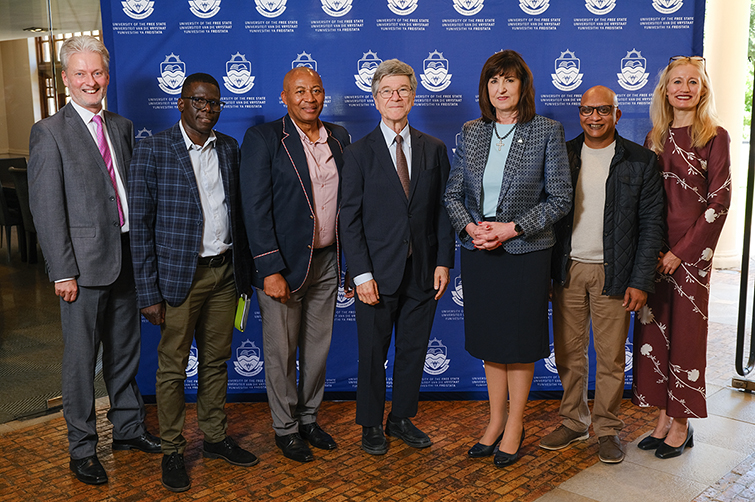 From left: Prof Philippe Burger (Dean of the Faculty of Economic and Management Sciences); Prof Sevias Guvuriro (Deputy Head of the Department of Economics and Finance); Dr Temba Hlasho (Executive Director: Student Affairs); Prof Jeffrey Sachs; Prof Hester C. Klopper (Vice-Chancellor and Principal); Prof Vasu Reddy (Deputy Vice-Chancellor: Research, Innovation and Postgraduate Studies); and Prof Ylva Rodny-Gumede (Executive Director: Advancement) at the UFS Prestige Lecture, held on 18 November 2025 at the Bloemfontein Campus.
As South Africa prepares to host the G20 Summit from 22 to 23 November 2025, the University of the Free State (UFS) stepped into an important continental conversation of its own. On 18 November 2025, staff, students, and partners gathered at the Centenary Complex on the Bloemfontein Campus for a Prestige Lecture, delivered by internationally renowned economist Prof Jeffrey Sachs.
The timing was unmistakably relevant. Prof Sachs, Professor and Director of the Centre for Sustainable Development at Columbia University and the recipient of an honorary doctorate from the UFS in 2015, presented a lecture titled ‘Strategies for Rapid Long-Term Growth in Africa’, offering a grounded and timely exploration of what it will take for the continent to unlock sustained development. With Africa standing at a pivotal moment defined by a young population, systemic inequality, and enormous potential, the event positioned the UFS as a space where critical, future-shaping ideas are taken seriously.
Unity, long-term investment, and education as the pillars of future growth
During her welcome of guests, Vice-Chancellor and Principal Prof Hester C. Klopper emphasised the role of universities in shaping responsible societal futures. “Lectures such as these represent our commitment to thought leadership and our determination to position the UFS as a space where critical conversations about our world's most pressing challenges can unfold,” she said. She added that the lecture topic “speaks directly to the heart of our continental aspirations and challenges”.
According to Prof Sachs, Africa’s pathway to rapid long-term growth lies in unity, interconnectedness, and the boldness to think and plan at continental scale. He emphasised that Africa cannot grow in isolation, stressing that the flow of knowledge, technology, and trade between nations is not optional, but foundational. “Interconnectedness is the key to the puzzle of how Africa can achieve rapid economic development,” he said, urging African countries to build partnerships with fast-growing economies such as China and India.
Using China’s 45-year development journey as an example, he illustrated how deliberate planning, infrastructure investment, and large-scale education reform can reshape a country’s economic trajectory. He argued that the most important productive asset Africa holds is the capability of its people, and that education remains the foundation of any meaningful growth strategy. He described education as “the literal truth of economic development”, placing universities and learning systems at the centre of the continent’s long-term ambitions.
His views aligned strongly with Prof Klopper’s reflections on the purpose of higher education. “Education is not merely a pathway to economic opportunity; it is the very fabric from which we weave the future of our societies,” she said, emphasising the need for ethical leadership, critical thinking, social cohesion, and a commitment to humanity.
Responding to the lecture, Prof Philippe Burger, Dean of the Faculty of Economic and Management Sciences, supported Prof Sachs’s emphasis on long-term investment and the value of quality education. He spoke about the need for infrastructure that supports economic participation, the importance of greener technologies, and the constitutional imperatives that guide the country’s development priorities. He also highlighted that education remains one of Africa’s strongest renewable resources, particularly when aligned with the needs of an evolving economy.
Prof Sachs and Prof Burger ultimately pointed to similar foundations for long-term African growth: stronger regional cooperation, sustained investment in infrastructure, and education systems that can develop the skills needed for a changing global economy. Both emphasised that these efforts require commitment across the continent and long-term planning rather than short-term fixes.
As the country enters a significant week on the global stage, the UFS has signalled its commitment to meaningful engagement with Africa’s most urgent development questions, anchoring itself as a university where ideas and action meet.
Watch the full lecture here: